

Recruiters are not looking for reasons to reject you. Most would rather find a strong candidate quickly and move on. But the way people apply for jobs has changed, and some habits now make even good candidates look careless.
And you can’t really blame recruiters for having their guard up when 81.6% have encountered AI-written cover letters.
That does not mean you have to avoid every shortcut or template, but your application does have to feel specific and traceable to your actual experience. The red flags below are patterns that make recruiters pause and ask themselves if you’re even qualified or genuinely interested.
Applying to Everything With the Same Resume
There is nothing wrong with applying to several jobs at once. The problem is when every application looks like it was sent in bulk.
Recruiters notice when a resume is technically qualified but completely disconnected from the role. This tells the recruiter that you either did not read the job posting, or you are applying so widely that this role does not matter much to you. Neither impression helps.
What to do: Keep one strong base resume, then adjust the top third for each role. Your summary and first few bullets should make it obvious why this specific job made sense to apply for.
Sending a Cover Letter That Sounds Like Everyone Else’s
A suspicious cover letter usually does not sound bad. It sounds smooth and polite, but more often than not, it also sounds soulless.
Recruiters see the same phrases over and over: excited to apply, fast-paced environment, strong communication skills, proven track record, passion for excellence. None of these are automatically wrong, but they do not tell anyone what you have actually done.
AI has made this worse because candidates can now produce a clean cover letter in seconds. According to Gartner research, 39% of candidates said they used AI during the application process.
What to do: Add one human detail that only you could write. Mention the type of work you have done, or a detail from the job description that connects to your experience. A slightly less polished letter with real substance beats a perfect one that could belong to anyone.
Making Your Experience Look Too Perfect
A resume that is too narratively neat can be suspicious too.
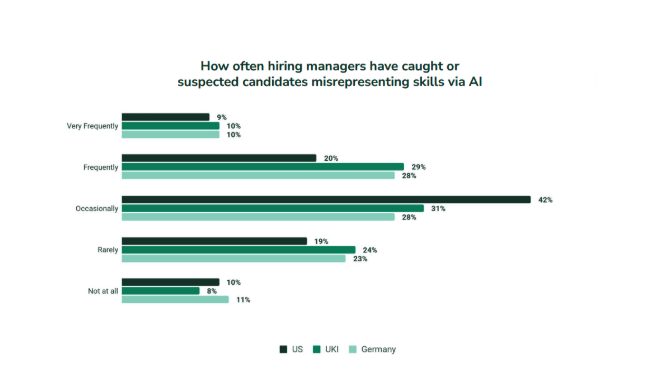
Real careers have gaps, pivots, short jobs, messy projects, and uneven growth. When every bullet claims a major win, and every skill is described at expert level, recruiters may wonder what has been exaggerated.
This matters more now because hiring teams are dealing with more questionable applications.
What to do: Let your resume sound accomplished but believable. Use numbers where you have them, but do not force a metric into every line.
Applying From the Wrong Angle
Some candidates hurt themselves by focusing only on what they want: remote work, a higher salary, a better title, a first chance, a visa, a flexible schedule. Those things may matter, but they should not be the whole application.
Even when you search through the best job boards, you’ll need to look hard to find roles where your experience and practical constraints overlap well enough to make a strong case.
What to do: Read the job posting and identify the employer’s pain point. Are they hiring because the team is overloaded, expanding into a new market, replacing someone, or improving customer support? Your resume and cover letter should aim to answer that need.
Stuffing Keywords Into the Resume
Keyword matching is generally a good idea, but keyword stuffing looks desperate.
A resume that repeats the same tools and phrases unnaturally can feel written for a machine rather than a person. Recruiters notice when a skills section lists every possible platform, but the work history does not show where those skills were used.
This is one of the easiest ways to lose credibility. If you list Salesforce, Excel, Tableau, HubSpot, Python, project management, SEO, paid ads, and payroll software, be ready to explain your actual level with each one.
What to do: Use the language of the job description where it genuinely fits, then prove it with context.
What Recruiters Want to See
Most recruiters want signs that you are qualified, and that you are paying attention.
A trustworthy application usually has a few simple qualities:
The resume matches the role.
The cover letter includes at least one specific, personal detail.
Claims are backed by examples.
Dates and titles are consistent.
The candidate follows instructions and communicates clearly.
None of this requires a flawless career history.
Suspicion usually comes from a distance between your resume and the job, between your claims and your evidence, between your public profiles and your application, or between the polished words and the person behind them.
Close that distance, and your application starts to feel more believable.