
More than half of employers now use AI somewhere in their hiring process. AI can scan your resume in seconds, flag missing keywords, and rank you against hundreds of other candidates — before a human ever reads a word.
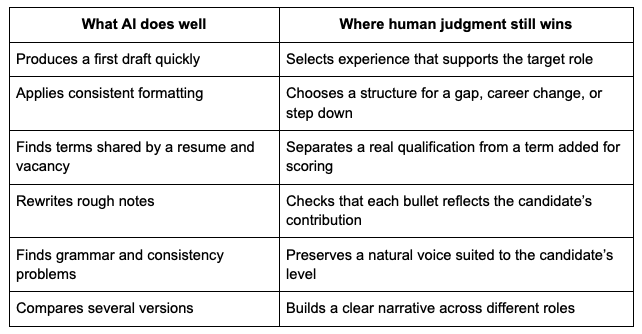
AI can also format a resume, compare it to a job description, and rewrite weak bullets in seconds (or what it deems to be ‘weak bullets’). What it can't do reliably is decide which parts of a person's career deserve attention.
The strongest process divides the work. AI handles repeatable tasks. The candidate or resume writer makes decisions about evidence, context, and positioning.
What Can AI Do in Resume Writing in 2026?
AI works well when a task has clear rules or patterns. Current tools can build a standard layout, identify missing terms, check ATS readability, and turn detailed notes into concise bullets.
Format a resume
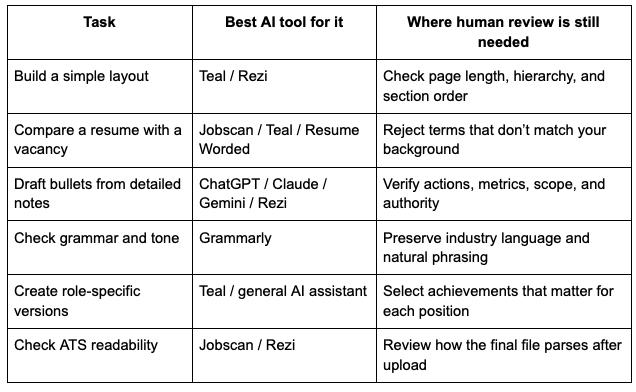
Builders such as Teal and Rezi place information into standard resume sections. They apply consistent fonts, headings, margins, and spacing. This is useful for candidates working with an outdated document or starting from scratch (without a template).
A simple layout can also prevent parsing errors. Graphics, text boxes, unusual headings, and complex columns may cause an applicant tracking system to read information in the wrong order.
AI can create the structure. A person still needs to check page length and hierarchy.
Compare a resume with a job description
Jobscan, Teal, Rezi, and the like compare resume content with a target vacancy. They can identify missing skills, credentials, job titles, and industry language.
Suppose a job post asks for customer lifecycle management, Salesforce, and retention reporting. The candidate’s resume says “managed customer relationships” and “prepared monthly reports.” A comparison tool can show that the wording is too broad.
Add an exact term only when it describes work you’ve done. If you used HubSpot rather than Salesforce, don’t add Salesforce to improve a score. That change creates a claim you may have to defend during an interview.
Write effective resume bullets
Generative tools can improve bullets when the candidate supplies detailed facts.
Original note:
Managed email campaigns. Used HubSpot. Open rates increased from 24% to 31% in six months.
This note includes a tool and a measurable result, but it doesn’t specify the size or type of campaign.
AI-assisted revision:
Managed segmented email campaigns in HubSpot, increasing open rates from 24% to 31% within six months.
AI improves structure and connects actions to results. However, “segmented” wasn’t included in the original notes, so the candidate must confirm that detail.
Professional resume writer’s revision:
Built three segmented lifecycle campaigns in HubSpot for 120,000 subscribers, raising average open rates from 24% to 31% in six months.
Human input adds a dimension AI can’t supply on its own. A Resumeble writer identifies which questions to ask, finds evidence missing from the original notes, and connects the result to the candidate’s actual scope of work.
How Recruiters Use AI to Screen Your Resume
Employers don’t all use the same software or scoring rules. Some applicant tracking systems organize resumes for a recruiter. Others add ranking tools, automated screening questions, or searches based on related skills.
SHRM’s 2025 research found that 43% of organizations used AI in HR and recruitment. Its 2026 study found that adoption reached 60% among extra-large organizations, compared with about one-third of small organizations. Recruiting remained the leading application, including resume screening and candidate matching.
Resume parsers extract information such as job titles, dates, skills, education, and certifications. Matching tools then compare parts of that information with the employer’s criteria.
Use the standard name of a skill when it appears in the vacancy. Write “search engine optimization” at least once if the employer uses that phrase, even if “SEO” appears elsewhere.
The same principle applies to licenses, software, and professional methods. If a vacancy requires financial planning and analysis, don’t replace every reference with “strategic finance work.” The broader phrase removes the exact qualification a recruiter may search for.
Where Does AI Fall Short in Resume Writing?
AI struggles when it must interpret experience rather than reorganize supplied information. It doesn’t know which project led to a promotion, why someone accepted a lower title, or how work in one field supports a move into another.
Why Does AI Misread Career Experience?
AI relies heavily on the information and labels it receives. If a title doesn’t resemble the target role, the tool may overlook transferable experience.
Consider a retail manager applying for an operations position. The candidate scheduled 35 employees, managed $800,000 in inventory, handled supplier delays, and reduced overtime costs. A weak draft may focus on customer service because the job title contains “retail.”
A career professional sees operations experience inside a retail setting. The same issue affects military veterans, returning caregivers, freelancers moving into permanent roles, and people changing industries. Their relevant abilities may sit behind unfamiliar titles.
How Does AI Exaggerate Resume Claims?
AI often produces language that sounds credible without being accurate. It may change “helped with onboarding” to “led the onboarding program.” It may also add a percentage because quantified bullets tend to sound stronger.
Check every generated bullet against five questions:
Did I perform the stated action?
Can I explain my personal contribution?
Is the number accurate or reasonably estimated?
Does the verb reflect my level of responsibility?
Could I discuss the example in detail during an interview?
What Does an AI Error Look like in Practice?
A complete example shows why human review matters.
Job description asks for:
Salesforce reporting
Sales forecasting
Pipeline analysis
Support for regional sales teams
Candidate’s original note:
Made sales reports and helped managers understand performance.
AI-generated bullet:
Developed Salesforce reports and forecasts that improved regional sales performance.
After checking the facts, the candidate provides more detail: they used HubSpot, prepared weekly pipeline reports, and supported four regional managers before forecast meetings.
Accurate final bullet:
Prepared weekly pipeline reports in HubSpot for four regional sales managers, helping them identify stalled deals before forecast meetings.
The final version contains specific evidence. It doesn’t claim Salesforce expertise or ownership of forecasting.
Candidates who need help with a career change or complex work history can compare the best options among services with human writers. Review writer access, revision terms, industry experience, and samples before choosing one.
How Should You Use AI in Your Resume Workflow?
Give AI one defined task at a time. A focused request produces a more useful result than a single prompt asking for a complete resume.
What Information Should You Give an AI Resume Tool?
Collect evidence before asking for a draft. For each role, record:
Projects completed
Problems solved
Software and methods used
Team, budget, customer, or territory scope
Changes in cost, time, quality, revenue, or volume
Promotions and added responsibilities
Positive feedback with supporting context
Use performance reviews, project reports, calendars, and old emails to recover details. These records can help confirm numbers and dates.
What Prompt Should You Use?
Set factual limits inside the prompt:
Rewrite these notes as two resume bullets for a senior customer success role. Use only the facts provided. Don’t invent metrics, tools, ownership, or outcomes. List any missing information as questions.
This turns missing evidence into follow-up questions. It also reduces the chance of receiving polished claims that aren’t true.
How Should You Review an AI-Written Resume?
Start with accuracy. Confirm dates, job titles, metrics, software, and your level of responsibility.
Check relevance. Each major bullet should support a duty, qualification, or business problem found in the target vacancy.
Finish with a recruiter review. Look for a clear target role and strong recent evidence. Remove generic lines that could describe almost any applicant.
Upload the final file to the employer’s application preview. Check that employers, titles, dates, and section headings appear in the correct order.
Which Parts of a Resume Still Require Human Judgment?
AI can find clearer words. It can’t decide which facts deserve a recruiter’s limited attention without informed input.
A person can see that a lateral move brought larger accounts. A person can explain that freelance work filled an employment gap and prepared someone for a permanent role. A person can also recognize when a modest title hides senior-level scope.
The resume must remain consistent with the candidate who attends the interview. Generic language, inflated authority, and invented metrics create expectations the person may not meet.
Use AI for formatting, comparison, and early drafts. Keep career positioning, factual decisions, and final wording in human hands.
Conclusion
AI has reduced the time needed to create and tailor a resume. It hasn’t removed the need to judge what belongs on the page. AI can help you find the right words. It can’t decide which parts of your career deserve the recruiter’s attention.
Let software handle repetitive checks and early drafting. Let a person choose the evidence, test each claim, and shape the career story.
FAQ
Will AI replace professional resume writers?
AI will take over more basic drafting and formatting work. Professional writers still contribute through interviews, career positioning, evidence selection, and decisions about complex work histories. Those tasks depend on personal context.
Should I use AI to write my resume?
Yes. Use it for first drafts, keyword checks, formatting, and sentence-level revisions. Supply accurate source material and review every statement. Don’t submit a claim you can’t verify or explain.
Can recruiters tell if a resume was written by AI?
AI detectors can flag patterns, though they can’t reliably prove how a resume was written. Recruiters are more likely to notice generic phrasing, unsupported claims, and differences between the resume and the interview.