
Updated: December 2025

Most cover letter advice tells you what to include. This guide shows you why it matters and how to do it from someone who's reviewed thousands of them from the hiring side.
After recruiting across accounting, finance, HR, operations, supply chain, marketing, and sales for over a decade, I've seen what separates cover letters that get interviews from those that get ignored. The difference isn't in following a template; it's in understanding how the hiring process actually works.
Table of Contents
When Do You Need to Send a Cover Letter
How to Write a Cover Letter (Section by Section)
Situtational Cover Letter Examples
How to Write a Cover Letter for an Internship
Cover Letter Mistakes to Avoid
Optimizing Cover Letters for ATS
When NOT to Submit a Cover Letter
Do You Really Need a Cover Letter?
Here's what the data actually says:
Only 26% of recruiters consider cover letters important. Jump on LinkedIn and you'll find countless recruiters saying they never read them.
But here's the critical part most advice misses: 74% of hiring managers prefer a cover letter, and over 80% read them when deciding who to interview.
Why the disconnect? Because recruiters and hiring managers operate at different stages of the hiring process.
The Two-Stage Reality:
Stage 1: Recruiters screen hundreds of applications, focusing on resumes to create a shortlist
Stage 2: Hiring managers review the shortlist and that's when your cover letter matters
Your resume gets you past the gatekeeper. Your cover letter influences the decision maker.
Even more compelling: only 35% of candidates submit cover letters. That means you're competing against a smaller pool when you include one.
When Should You Write a Cover Letter?
Writing a cover letter for every application hits diminishing returns fast. As someone who’s been in the room when interview decisions are made, here's when the investment pays off:
1. Career Changes
When transitioning industries or roles, hiring managers won't connect the dots themselves. Your cover letter must explicitly translate your experience.
Bad Example (Generic): "I have transferable skills that make me qualified for this accounting role. My previous experience in retail management taught me attention to detail and organization."
Good Example (Specific Translation): "While my background is in manufacturing operations management, the financial principles are remarkably similar to construction accounting. At Acme Manufacturing, I managed work-in-process inventory worth $2.3M monthly, reconciling material costs across multiple production runs - the same WIP accounting challenges construction firms face with job costing. I also prepared monthly variance analyses comparing standard costs to actuals, identifying $180K in material waste that we reduced by 34% through process improvements."
Why it works: Demonstrates actual understanding of construction accounting terminology (WIP, job costing, variance analysis) and helps the hiring team understand similarities between your work and the work that you’re applying to do. Remember, others who don’t have your same background won’t understand what you do unless you tell them.
2. Tier 1 Target Companies
For jobs where you're genuinely excited and well-qualified, the extra effort can push you ahead of the 65% who don't submit one. The key here is that you’re excited AND well-qualified.
3. Internal Referrals
When someone at the company referred you, the cover letter is your chance to leverage that connection early.
Example Opening: "Cole Sperry in your Customer Success department suggested I reach out about this Financial Analyst position. After discussing your company's expansion into renewable energy accounting, and my three years managing financial models for solar installations at GreenTech Solutions, I'm confident this role could be a great fit."
Why it works: Name-drops the referral immediately, mentions a specific company initiative (showing research), and connects experience directly to that initiative.
4. Addressing Potential Red Flags
If you're concerned something in your background might eliminate you unfairly (employment gap, relocation, overqualification), get ahead of it.
Example (Addressing Relocation): "I'm relocating to Seattle in March to be closer to family. My sister lives in Capitol Hill, and I'm coordinating the move to ensure I'm available to start by April 1st. I'm familiar with the Seattle market from visiting quarterly for the past three years."
Why it works: Removes doubt about commitment, provides specific timeline, and demonstrates local knowledge.
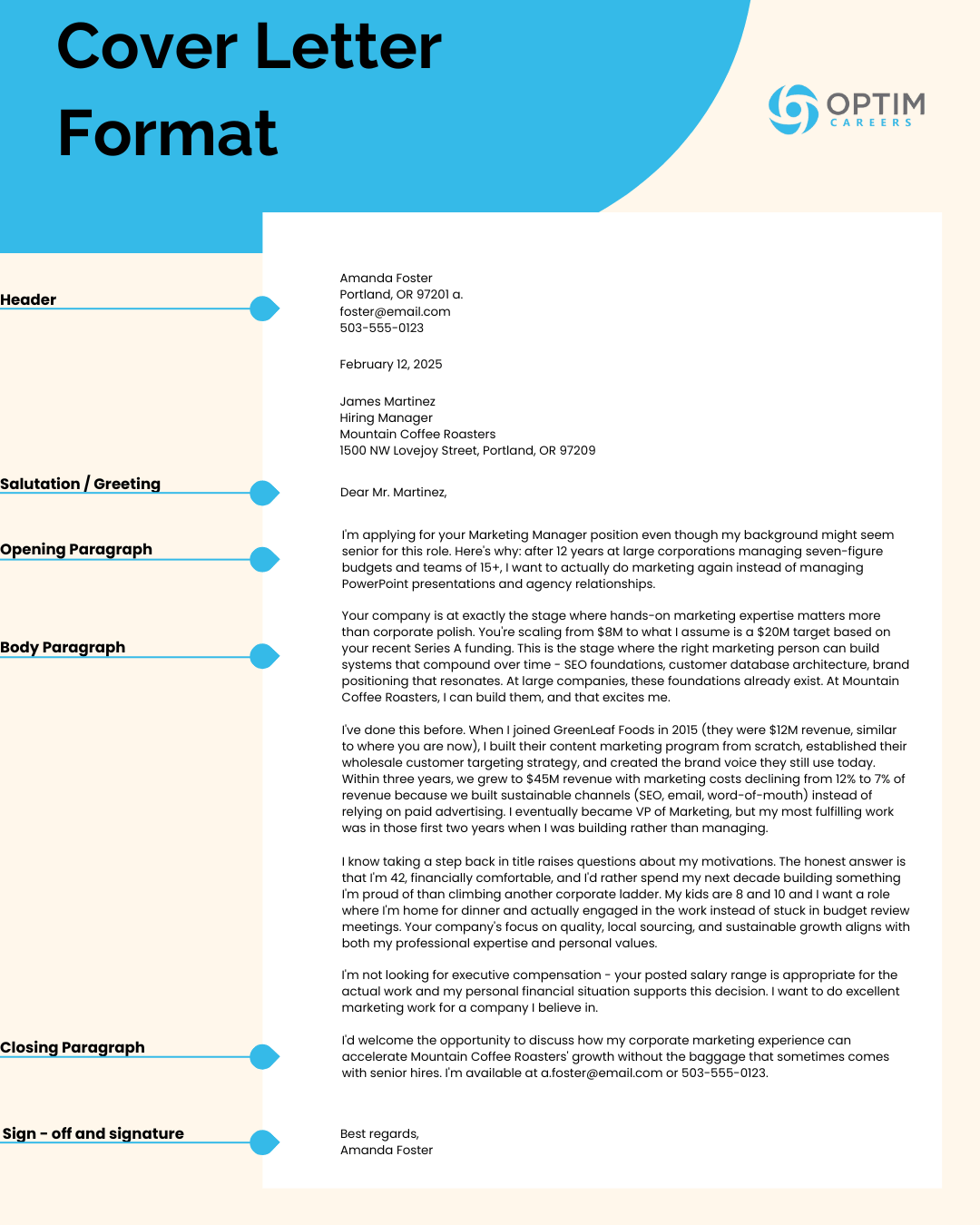
How to Format a Cover Letter
Standard Structure
Your cover letter should include:
Header:
Your contact information (name, city/state, phone, email)
Date
Hiring manager's name and company address (if known)
Greeting:
Find the hiring manager's name whenever possible
"Dear [First Name Last Name]" or "Dear [Title] Team"
Avoid "To Whom It May Concern" or "Dear Hiring Manager"
Body (3-4 paragraphs):
Opening: Why you're writing and your hook
Middle 1-2: Your qualifications with specific examples
Closing: Next steps and enthusiasm
Sign-Off:
"Sincerely" or "Best regards"
Your name
Formatting Specifications
Length: 3/4 to 1 full page maximum
Font: Same as your resume (Arial, Calibri, or Times New Roman, 10-12pt)
Margins: 1 inch on all sides
Spacing: Single-spaced within paragraphs, space between paragraphs
File format: PDF unless otherwise specified
How to Write Each Section
The Opening Paragraph
Your opening must accomplish three things simultaneously: identify the position, explain why you're interested, and give them a reason to keep reading.
Weak Opening: "I am writing to apply for the Marketing Manager position at your company. I believe I would be a good fit for this role based on my experience."
Strong Opening: "When I saw your Marketing Manager opening, I immediately recognized the challenge: you're launching into the healthcare SaaS space for the first time. Having navigated a nearly identical expansion at MedTech Solutions, growing our healthcare vertical from zero to $4.2M ARR in 18 months, I know exactly what this role requires."
Why it works: Demonstrates research (healthcare SaaS expansion), establishes credibility with relevant accomplishment, creates intrigue about how you did it.
Another Strong Opening (Career Changer): "I'm applying for your Operations Analyst role because operations problems and accounting problems are more similar than most people realize - both come down to process optimization and variance analysis. My four years in accounts payable taught me to identify inefficiencies ($340K recovered from duplicate payments), automate workflows (reduced invoice processing time 60%), and analyze variances (built dashboard tracking 23 cost centers). Based on your posting, these also appear to be the skills operations analysis requires."
Why it works: Directly addresses the career change, draws explicit parallels between fields, leads with quantified achievements.
The Middle Paragraphs: Proving Your Value
This is where most cover letters fail. They either:
Regurgitate bullet points from their resume
Make vague claims about being "hard-working" or "detail-oriented"
List responsibilities instead of achievements
Instead, select 2-3 specific accomplishments that directly align with the job requirements and explain them as mini case studies.
Formula: Challenge + Your Action + Measurable Result + Relevance to This Job
Example 1 (Sales Role): "In the job description, you mentioned struggling with long sales cycles in enterprise accounts. At my current company, I faced the same challenge - our average enterprise deal took 9 months to close. I developed a multi-threading strategy that involved mapping all decision makers early, customizing ROI calculators for each stakeholder, and setting milestone commitments at each meeting. This approach reduced our average sales cycle to 5.5 months while increasing deal size by 32% because we engaged C-level sponsors earlier in the process. For your healthcare vertical, this same framework might accelerate the medical device manufacturer accounts you're targeting."
Why it works: Identifies specific job requirement, proves you've solved this problem before, quantifies the improvement, connects it to their specific market.
Example 2 (Operations Role): "Your job posting emphasizes supply chain optimization. At Midwest Manufacturing, our biggest challenge was component shortage delays costing us $450K in expedited shipping annually. I implemented a dual-sourcing program for our 15 highest-risk components, negotiated buffer stock agreements with three suppliers, and built a predictive model using 18 months of demand data. Result: we reduced expedited shipping costs by 73% ($328K savings) and improved on-time delivery from 84% to 97%. Given your recent production delays mentioned in the Q3 earnings call, my experience with supplier diversification could be of immediately valuable."
Why it works: Shows you researched them (Q3 earnings call), proves capability with specifics, quantifies impact, demonstrates analytical thinking.
Example 3 (HR Role): "Employee retention appears to be a priority based on the job requirements. In my current role, we had 34% annual turnover in our customer service department, 12 points above industry average. I launched a structured feedback program with monthly one-on-ones, created career pathing frameworks for three promotion levels, and redesigned our recognition program based on employee surveys (which revealed people wanted project-based learning over gift cards). Over 18 months, turnover dropped to 19%, and we saved approximately $280K in recruiting and training costs. More importantly, our customer satisfaction scores improved 8 points because we had more experienced representatives. This systematic approach to retention might also address the turnover challenges you could be experiencing in client services."
Why it works: Addresses their specific pain point, shows problem-solving methodology, connects retention to business outcomes (customer satisfaction), demonstrates understanding of their department.
The Closing Paragraph
Your closing should:
Restate your enthusiasm for the specific role
Make it easy to take the next step
Show confidence without arrogance
Weak Closing: "Thank you for considering my application. I look forward to hearing from you. Please feel free to contact me if you have any questions."
Strong Closing: "This Operations Manager role combines two things I'm exceptionally good at: optimizing complex workflows and leading cross-functional teams through change. I'm excited about the possibility of bringing my process improvement methodology to Acme Corp's warehouse expansion. I'll follow up next week to see if you need any additional information. In the meantime, I'm available at 555-0123 or jane.smith@email.com."
Why it works: Specific to the role, shows proactive follow-up intent, provides contact information, confident without being presumptuous.
Another Strong Closing (Career Changer): "I know making a career change hiring decision requires confidence that the candidate truly understands what they're getting into. I've spent the past six months taking courses in SQL and Python specifically to prepare for this data analyst transition, and I've completed three personal projects analyzing e-commerce data (available in my portfolio). This isn't a whim; it's a calculated career move I'm fully prepared for. I'd welcome the opportunity to discuss how my financial analysis background translates to this role."
Why it works: Addresses the obvious concern about career change, provides evidence of commitment, shows self-awareness.
Complete Cover Letter Examples
Example 1: Mid-Level Professional (Marketing Manager)
Sarah Chen | Seattle, WA 98101 | sarah.chen@email.com | 206-555-0123
March 15, 2025
Jennifer Martinez
Marketing Director
CloudTech Solutions
1500 4th Ave, Seattle, WA 98101
Dear Ms. Martinez,
When I saw your Marketing Manager opening, I immediately recognized the challenge: you're launching into the healthcare SaaS space for the first time. Having navigated a nearly identical expansion at MedTech Solutions, growing our healthcare vertical from zero to $4.2M ARR in 18 months, I know exactly what this challenge requires.
The healthcare market requires a fundamentally different approach than your traditional B2B tech customers. Procurement cycles are longer (7-9 months average in my experience), buying committees are larger (typically 8-12 stakeholders), and compliance concerns drive every decision. At MedTech Solutions, I developed a content strategy that addressed each stakeholder's specific concerns: ROI calculators for CFOs, compliance white papers for IT security teams, and workflow optimization case studies for end users. This segmented approach increased our healthcare demo booking rate from 3% to 11% and reduced the sales cycle by 60 days compared to our previous generic approach.
Your job description mentions building a healthcare-specific marketing team. I've done exactly this, hiring three specialists (one focused on content with clinical backgrounds, one on healthcare digital advertising, and one on event marketing for medical conferences). I also developed partnerships with four healthcare industry publications that generated 340 qualified leads last year at 40% below our standard CAC. The team structure I built scaled efficiently from supporting $2M to $12M in healthcare pipeline over two years.
I'm particularly drawn to CloudTech's patient engagement platform because I see the same market gap we successfully exploited at MedTech: healthcare providers want better technology but lack the IT resources to implement complex solutions. Your emphasis on implementation support and outcome-based pricing addresses this perfectly. I'd love to bring my healthcare go-to-market experience to accelerate CloudTech's entry into this market.
I'm available at sarah.chen@email.com or 206-555-0123 and happy to provide additional work samples, including the healthcare persona research framework and content strategy I developed. I'll follow up next week to see if you'd like to schedule a conversation.
Best regards,
Sarah Chen
Example 2: Career Changer (Retail to HR)
Michael Rodriguez | Austin, TX 78701 | m.rodriguez@email.com | 512-555-0123
February 8, 2025
Rebecca Thompson
Human Resources Director
Sterling Financial Group
500 Congress Ave, Austin, TX 78701
Dear Ms. Thompson,
I'm applying for your HR Generalist position because running a retail store is 70% people management and 30% operations, and the people management skills translate directly to HR. Over five years as Store Manager at Summit Retail, I've handled hiring (recruited and onboarded 45 employees), performance management (conducted 180+ performance reviews), employee relations (resolved complaints ranging from scheduling conflicts to harassment allegations), and retention strategies (reduced turnover from 89% to 52% in a notoriously high-turnover industry).
Your job description emphasizes employee relations and conflict resolution. In retail, I dealt with workplace conflicts daily, everything from shift assignment disputes to allegations of discriminatory treatment. When two assistant managers filed harassment complaints against each other, I conducted thorough interviews with six witnesses, documented everything according to company protocol, and worked with our regional HR director to implement a resolution that included mediation and revised team structures. Both employees remained with the company and their working relationship improved significantly. This experience taught me the importance of impartiality, documentation, and following legal protocols - exactly what HR generalist work requires.
I also have practical experience with the specific HR functions mentioned in your posting. I've coordinated FMLA requests (worked with corporate HR to process leave for three employees last year, ensuring proper documentation and communication), handled workers' compensation claims (filed seven injury reports, coordinated modified duty assignments, and maintained perfect compliance with state reporting deadlines), and assisted with benefits enrollment for 40 employees each year. During our annual enrollment period, I noticed employees were confused about the difference between our two healthcare plans, so I created a simple comparison chart and held three voluntary Q&A sessions during shift changes. This reduced benefits-related questions to our corporate HR team by 60% and improved enrollment completion rates from 73% to 94%.
To prepare for this career transition, I've completed the SHRM-CP certification and taken specialized courses in employment law and compensation analysis. I know retail isn't traditional HR experience, but managing people is managing people, and I've done it successfully in an environment where employee turnover averages 70% industry-wide. My results speak to my ability to engage, retain, and develop talent.
I'm eager to discuss how my people management experience translates to your HR team. I'm available at m.rodriguez@email.com or 512-555-0123.
Sincerely,
Michael Rodriguez
Example 3: Recent Graduate (Entry-Level Financial Analyst)
Jessica Park | New York, NY 10001 | jessica.park@email.com | 917-555-0123
January 20, 2025
David Kim Senior
Finance Manager
Apex Investments
123 Wall Street, New York, NY 10005
Dear Mr. Kim,
I'm applying for your Financial Analyst position because your focus on renewable energy investments aligns with both my finance background and my specific studies in energy sector valuation. As a recent NYU Stern graduate with a finance degree, I've spent the past two years deliberately building expertise in this exact niche, from coursework in energy economics to my thesis analyzing LCOE trends in utility-scale solar projects.
During my internship at GreenTech Capital, I worked on three renewable energy project financings totaling $450M. My primary responsibility was building financial models for two solar farms (120MW combined capacity) and one offshore wind project (45MW). I learned to model merchant revenue risk, project tax equity structures, and calculate LCOEs accounting for ITC step-downs and varying capacity factors. For the offshore wind project, my sensitivity analysis identified that O&M costs were 22% higher than industry benchmarks, prompting us to renegotiate the service contract and improve project IRR by 1.8 percentage points.
Your job description mentions supporting investment committee presentations. At GreenTech, I created IC memos for all three projects I modeled. This taught me to distill complex financial models into clear recommendations; for example, explaining why a 15-year PPA with a 2.5% annual escalator was superior to a 20-year contract with fixed pricing, even though the latter appeared more stable on the surface. Two of my three investment committee recommendations were approved, and both projects are now operational and performing above our underwritten returns.
I know most analysts aren't hired until they have an MBA or CFA, but I've deliberately built renewable energy finance experience that I hope you’ll find valuable beyond an MBA alone. I'd welcome the opportunity to discuss how I can contribute immediately to your investment pipeline. I'm available at jessica.park@email.com or 917-555-0123.
Best regards,
Jessica Park
Example 4: Senior Executive (CFO)
Robert Anderson | Chicago, IL 60601 | robert.anderson@email.com | 312-555-0123
March 1, 2025
Board of Directors
Midwest Manufacturing Corporation
c/o Executive Search Committee
1000 W. Fulton Market, Chicago, IL 60607
Dear Search Committee Members,
I'm interested in the Chief Financial Officer position at Midwest Manufacturing because you're at a critical inflection point: managing the transition from family ownership to private equity backing while simultaneously modernizing operations. I've navigated this exact transformation twice before, and in both cases, improved EBITDA by over 30% within 18 months while maintaining the company culture that made the business successful.
At Precision Components (acquired by Riverside Partners in 2019), the PE firm wanted aggressive growth but the founding family had run a conservative, underleveraged business for 40 years. As CFO, I bridged these competing priorities by implementing a 13-week cash flow forecasting system that gave the board confidence to support a $15M capex investment in automated machining equipment. This investment increased production capacity 40% while reducing labor costs 25%, allowing us to secure three major automotive contracts worth $28M annually. EBITDA grew from $12M to $18M during my tenure, and we achieved a successful exit at 8.2x (vs. 5.5x entry multiple).
Your board memo mentions the need for upgraded financial systems and improved cost accounting. Manufacturing companies often underinvest in these areas, then struggle to understand their true unit economics. At Precision Components, we replaced a 15-year-old ERP system with a modern cloud-based platform, implemented activity-based costing across our four product lines, and discovered we were losing money on 22% of our SKUs. We then repriced or discontinued unprofitable products, added $2.1M to the bottom line, and gave the sales team better tools to evaluate custom quote requests. This same systems-and-analytics approach would address the cost visibility challenges mentioned in your CFO specification.
I also understand the cultural dynamics of PE-backed manufacturing companies. The best results come from respecting the institutional knowledge of long-tenured employees while introducing appropriate financial rigor. At Precision Components, I kept the plant controller (28 years with the company) and paired her with a new FP&A director I hired from McKinsey. This combination of operational knowledge and analytical sophistication proved more effective than replacing the entire team, which is what the PE firm initially suggested.
Midwest Manufacturing's portfolio of industrial components is similar enough to my background that I can add value immediately, yet different enough to keep me engaged with new challenges. I'd welcome the opportunity to discuss your specific growth objectives and PE partnership priorities in more detail.
I'm available at robert.anderson@email.com or 312-555-0123. I can provide additional references from PE partners and board members I've worked with previously.
Sincerely,
Robert Anderson
Example Openings for Different Situations
Opening for a Referral
"When Laura Chen from your product team mentioned this UX Designer opening, she specifically said, 'We need someone who can translate complex B2B software features into interfaces that sales reps actually want to use.' Having spent three years designing interfaces for Salesforce AppExchange applications, this is precisely what I do and why your role caught my attention."
Opening When You're Relocating
"I'm relocating to Los Angeles in April to be closer to family (my partner accepted a position at UCHealth), and I'm specifically targeting sustainability-focused companies in the area. Your Environmental Project Manager role combines my civil engineering background with my passion for renewable energy - exactly the opportunity I'm looking for in my next chapter."
Opening When Overqualified
"I know my background might seem senior for this Program Manager role, but I'm specifically seeking a position where I can focus on execution rather than strategy and politics. After 15 years at large global companies, I'm ready to trade the VP title for the chance to actually build and ship products at a growth-stage startup. Your Series B funding and aggressive product roadmap are precisely why I'm excited about this opportunity."
Opening for Career Change
"Most people wouldn't see the connection between teaching high school math and data analytics, but it's the same fundamental skill: taking complex information and explaining it in ways different audiences can understand and act on. Except now, instead of explaining quadratic equations to teenagers, I'll be explaining regression analyses to executives."
Opening for Competitive Position
"I noticed this Marketing Director posting has been open for three months, which tells me you most likely haven't found someone who combines B2B SaaS marketing expertise with healthcare industry knowledge. Having run demand generation for two healthcare SaaS companies (one through acquisition, one through IPO), this is my exact niche, and I was excited to see you had this opening."
Example Middle Paragraphs for Different Scenarios
For Someone With Perfect Experience Match
"Your job description mentions complex revenue recognition challenges under ASC 606, particularly for multi-element software arrangements. At CloudSoft Corporation, I faced this exact challenge when we launched professional services add-ons and sales started structuring deals that created revenue recognition nightmares. Rather than just reviewing contracts and telling sales 'no,' I built a contract template library with pre-approved language for common scenarios; each template included the revenue recognition treatment so sales could see the financial impact upfront. This reduced our revenue recognition review time from 4 days per contract to same-day turnaround for 80% of deals while improving compliance. More importantly, it changed the relationship between accounting and sales from adversarial to collaborative. I mention this because your company's expansion into enterprise accounts will create similar complexity, and you need someone who can build scalable systems while maintaining strong cross-functional relationships- not just someone who knows the technical accounting."
For Career Changer
"I understand the skepticism about hiring someone without traditional consulting experience. But running a $4M P&L as a retail district manager involves the same core skills consulting requires: diagnosing problems, analyzing data, developing recommendations, and managing client (in my case, regional management) expectations. The only difference is scale and variety. When our regional sales dropped 15% in Q1 2024, I conducted a systematic analysis of customer traffic patterns, competitor pricing, and employee feedback. I discovered the real issue wasn't our pricing or product mix; it was inconsistent store staffing during peak hours that created poor customer experiences. I developed a revised scheduling model, reallocated labor hours based on traffic data, and improved customer satisfaction scores 12 points while reducing total labor costs 3%. This is exactly the problem-solving methodology consultants use, applied to a retail environment."
For Recent Graduate
"I know I don't have traditional work experience, but I've deliberately treated my academic career like a job. As president of the Finance Club, I managed a $40K budget (securing $25K in new corporate sponsorships), organized twelve events with over 500 total attendees, and recruited/managed a team of eight board members. When attendance at our events dropped 30% between fall and spring semester, I surveyed 120 students, discovered that timing conflicts and lack of industry diversity were the main issues, and redesigned our event calendar to include more diverse industries and better time slots. Attendance recovered to pre-decline levels within two months. This experience taught me project management, stakeholder communication, and data-driven decision making - skills that translate directly to this analyst role."
For Addressing Employment Gap
"You'll notice a two-year gap in my employment from 2020-2022. During this time, I was the primary caregiver for my father during his cancer treatment. I returned to work in 2022 at a smaller company specifically because I wanted to rebuild my skills without the immediate pressure of a large corporate role. Over the past two years, I've refreshed my technical skills (completed three certification courses in data visualization and Python), taken on increasingly complex projects (most recently led a successful ERP implementation), and I'm now ready to return to a role with the scope and complexity this position offers."
Cover Letter Examples by Scenario
Example: Recent Graduate, No Experience
Jordan Thompson | Boston, MA 02108 | j.thompson@email.com | 617-555-0123
February 15, 2025
Ms. Patricia Lewis
Recruiting Manager
Boston Consulting Group
200 Pier 4 Blvd, Boston, MA 02210
Dear Ms. Lewis,
It’s my understanding that consulting firms hire Associate Consultants for their problem-solving ability, not their industry expertise, and I have a track record of solving problems nobody asked me to solve.
During my junior year at Boston University, I noticed our student-run investment fund consistently underperformed the S&P 500 despite having 30 smart, motivated members. I wasn't on the leadership team, but I analyzed three years of fund performance data and identified the problem: we made too many small-cap bets based on individual member recommendations without systematic evaluation criteria. I proposed a new framework that required minimum market cap thresholds, formal thesis presentations, and devil's advocate sessions for each position. The fund president implemented my recommendations, and our returns improved from -3.2% vs. S&P to +2.1% vs. S&P over the next 12 months.
I believe this is a consulting skill set in action: identify the problem, analyze the data, develop recommendations, and drive implementation. At BCG, the industries will change constantly, but this analytical methodology stays the same.
Your job description emphasizes client communication skills. I've developed these through my role as Teaching Assistant for Business Statistics (120 students), where I learned to explain complex analytical concepts to people who often struggled with math. I also led a team project analyzing Wayfair's supply chain strategy that involved interviewing three industry professionals, building financial models, and presenting our recommendations to a panel of professors and executives. Our team received the highest grade in the class and positive feedback on our presentation clarity.
I know most BCG hires have multiple internships at consulting firms or investment banks. I don't have that traditional path, but I've deliberately sought out experiences that build the same skills: analytical problem-solving, client communication, and project management. I've also prepared specifically for consulting by completing two case interview preparation courses and practicing with alumni from five different firms.
I'm excited about the possibility of joining BCG and would welcome the opportunity to discuss how my analytical background and problem-solving approach would contribute to your projects. I'm available at j.thompson@email.com or 617-555-0123.
Best regards,
Jordan Thompson
Example: Explaining a Layoff
Marcus Williams | San Francisco, CA 94102 | marcus.williams@email.com | 415-555-0123
January 25, 2025
Sarah Park
VP of Engineering
TechFlow Systems
100 California Street, San Francisco, CA 94111
Dear Ms. Park,
I'm excited to apply for your Senior Software Engineer position because building scalable payment processing systems is exactly what I've spent the past four years doing, most recently at Fintech Solutions, where I was part of the 15% workforce reduction in December 2024.
The layoff was part of a strategic decision to consolidate our engineering teams after our acquisition by MegaBank. They already had an established payment processing team in Charlotte and decided to eliminate the redundant San Francisco function. While disappointing, this gives me the opportunity to join a company like TechFlow that's actively growing its payment infrastructure rather than consolidating it.
At Fintech Solutions, my primary achievement was redesigning our payment reconciliation system to handle 10x transaction volume when we onboarded our largest client (a major e-commerce platform processing $200M monthly). The existing system couldn't scale past 500K transactions per day without significant latency issues. I architected a new event-driven system using Apache Kafka and distributed ledger technology that processes 8M transactions daily with 99.99% uptime and reduced reconciliation time from 36 hours to 4 hours. This project directly enabled our biggest revenue win of 2024.
Your job description mentions challenges with payment processing reliability and speed. This is precisely the type of infrastructure problem I solve. I'd welcome the opportunity to discuss how my payment systems experience would help TechFlow achieve its transaction processing goals.
I'm immediately available to start and can provide references from both my manager and the director of engineering who led our team. You can reach me at marcus.williams@email.com or 415-555-0123.
Best regards,
Marcus Williams
Example: Overqualified Candidate
Amanda Foster | Portland, OR 97201 | a.foster@email.com | 503-555-0123
February 12, 2025
James Martinez
Hiring Manager
Mountain Coffee Roasters
1500 NW Lovejoy Street, Portland, OR 97209
Dear Mr. Martinez,
I'm applying for your Marketing Manager position even though my background might seem senior for this role. Here's why: after 12 years at large corporations managing seven-figure budgets and teams of 15+, I want to actually do marketing again instead of managing PowerPoint presentations and agency relationships.
Your company is at exactly the stage where hands-on marketing expertise matters more than corporate polish. You're scaling from $8M to what I assume is a $20M target based on your recent Series A funding. This is the stage where the right marketing person can build systems that compound over time - SEO foundations, customer database architecture, brand positioning that resonates. At large companies, these foundations already exist. At Mountain Coffee Roasters, I can build them, and that excites me.
I've done this before. When I joined GreenLeaf Foods in 2015 (they were $12M revenue, similar to where you are now), I built their content marketing program from scratch, established their wholesale customer targeting strategy, and created the brand voice they still use today. Within three years, we grew to $45M revenue with marketing costs declining from 12% to 7% of revenue because we built sustainable channels (SEO, email, word-of-mouth) instead of relying on paid advertising. I eventually became VP of Marketing, but my most fulfilling work was in those first two years when I was building rather than managing.
I know taking a step back in title raises questions about my motivations. The honest answer is that I'm 42, financially comfortable, and I'd rather spend my next decade building something I'm proud of than climbing another corporate ladder. My kids are 8 and 10 and I want a role where I'm home for dinner and actually engaged in the work instead of stuck in budget review meetings. Your company's focus on quality, local sourcing, and sustainable growth aligns with both my professional expertise and personal values.
I'm not looking for executive compensation - your posted salary range is appropriate for the actual work and my personal financial situation supports this decision. I want to do excellent marketing work for a company I believe in.
I'd welcome the opportunity to discuss how my corporate marketing experience can accelerate Mountain Coffee Roasters' growth without the baggage that sometimes comes with senior hires. I'm available at a.foster@email.com or 503-555-0123.
Best regards,
Amanda Foster
How to Write a Cover Letter for an Internship
Internship cover letters require a different approach because you're selling potential instead of proven experience. Here's what works:
What Makes Internship Cover Letters Different
Focus on:
Academic achievements and coursework
Relevant projects (class projects, personal projects, extracurriculars)
Transferable skills from part-time jobs, volunteering, or campus activities
Eagerness to learn and contribute
Specific interest in the company and industry
Avoid:
Apologizing for lack of experience
Generic statements about "wanting to learn"
Listing every class you've taken
Focusing on what you'll gain instead of what you'll contribute
Internship Cover Letter Formula
Opening Paragraph:
State the specific internship position
Mention your school and major
Include one compelling reason why you're interested (specific to the company)
Optional: Reference a connection or how you learned about the opportunity
Middle Paragraphs:
Academic Achievement: Highlight relevant coursework or academic projects with specific results
Applicable Experience: Connect ANY experience (campus organizations, part-time jobs, volunteer work) to the internship requirements
Technical Skills: List specific tools, software, or methodologies you know
Closing:
Express enthusiasm for learning
Mention your availability (summer, semester, year-round)
Thank them and provide contact information
Complete Internship Cover Letter Example
Example: Sophomore Applying for Marketing Internship
Emily Rodriguez | Ann Arbor, MI 48104 | emily.rodriguez@umich.edu | 734-555-0123
March 10, 2025
Mr. Kevin Park
Internship Coordinator
Digital Dynamics Agency
500 W. Madison Street, Chicago, IL 60661
Dear Mr. Park,
I'm applying for the Summer 2025 Marketing Internship at Digital Dynamics Agency. As a sophomore at the University of Michigan studying marketing with a focus on digital strategy, I'm specifically drawn to your agency's work with sustainability-focused brands - an industry I'm passionate about pursuing after graduation.
In my Consumer Behavior class, I led a team project analyzing Patagonia's social media strategy across four platforms. We tracked 90 days of engagement data, identified which content types drove the highest conversion to website visits (user-generated content featuring products in use outperformed professional photography by 34%), and presented recommendations to our professor and two marketing professionals from local agencies. This project taught me how to analyze social media metrics, identify patterns, and develop data-driven recommendations - exactly what your internship description emphasizes.
I also bring practical digital marketing experience from my role as Social Media Coordinator for Michigan's Environmental Student Association. I grew our Instagram following from 340 to 1,200 followers in six months by creating a consistent content calendar, using campus sustainability events for real-time content, and partnering with three other student organizations for cross-promotion. I also managed our $800 annual budget for Facebook ads, which generated 45 new member sign-ups for our Earth Week events. While the scale is smaller than Digital Dynamics' client work, the fundamentals are the same: audience growth, engagement metrics, and budget management.
Additionally, I have technical skills relevant to this internship:
Google Analytics (completed Google Analytics certification)
Adobe Creative Suite (Photoshop, Illustrator, Premiere Pro)
Social media management platforms (Hootsuite, Buffer)
Basic HTML/CSS from a web design course
I'm particularly excited about Digital Dynamics' client roster in renewable energy and sustainable consumer products. This aligns perfectly with my career goal of working in marketing for environmentally conscious companies. I'm available for a full-time internship from May 15 through August 15, 2025, and would be thrilled to contribute to your team's client campaigns.
Thank you for considering my application. I'm available at emily.rodriguez@umich.edu or 734-555-0123 and would welcome the opportunity to discuss how I can contribute to Digital Dynamics this summer.
Best regards,
Emily Rodriguez
More Internship Opening Examples
For Finance Internship: "I'm applying for the Summer 2025 Investment Banking Analyst internship at Goldman Sachs. As a junior at Wharton studying finance with a concentration in corporate finance, I've spent the past two years deliberately building skills in financial modeling and valuation analysis - most recently completing a 60-page equity research report on the semiconductor industry that my professor submitted to the university's investment competition."
For Engineering Internship: "When I saw your Mechanical Engineering internship posting, I was excited because of the challenge you stated: you're redesigning your industrial HVAC systems for improved energy efficiency. In my Thermodynamics II class, I led a team project that performed nearly identical analysis for a campus building, identifying opportunities to reduce energy consumption by 28% through equipment upgrades and control system modifications."
For Consulting Internship: “I'm applying for Deloitte's Summer Business Analyst internship because I want to solve complex business problems across multiple industries. As Vice President of Finance for Michigan's $120K student government budget, I discovered we were losing $15K annually through inefficient vendor contracts and payment processing fees that nobody had questioned in five years. I negotiated new terms with four vendors and consolidated payment processing, recovering those costs for student programs. This experience taught me that the most valuable problems to solve are often the ones nobody's looking for, which I believe is exactly the mindset consulting requires."
Internship Middle Paragraph Examples
Connecting Coursework to Real Requirements: "Your internship description mentions analyzing customer data to identify trends. In my Marketing Analytics course, I worked with a dataset of 50,000 customer transactions from a local retailer, using Excel pivot tables and regression analysis to identify which customer segments had the highest lifetime value. I discovered that customers who made their first purchase during holiday sales had 40% lower retention rates than those acquired through other channels - a finding that led to our recommendation to modify the company's promotional strategy. This experience taught me to extract actionable insights from large datasets, which I hope is exactly what this internship requires."
Connecting Part-Time Work to Internship: "I understand that my barista experience might not seem relevant to a consulting internship, but managing the morning rush at a high-volume Starbucks taught me skills that directly translate: working under pressure (serving 200+ customers during 2-hour rush periods), efficiency optimization (I reorganized our prep station layout to reduce drink preparation time by 20 seconds per order), and customer service (maintaining positive interactions even when customers were frustrated by wait times). Consulting requires the same ability to perform excellently under pressure while maintaining professional relationships."
For Career Switcher (Non-Traditional Student): "I know my path is less traditional; I'm a 28-year-old junior returning to school after working in retail management for six years. But this experience gives me advantages most intern candidates don't have: I've managed P&L responsibility ($3.2M annually), led teams (12 direct reports), and made decisions with real consequences. I'm not learning what accountability feels like for the first time; I'm applying tested leadership skills to a new industry. My age and experience mean I'll contribute at a higher level than typical interns while still bringing fresh perspective and eagerness to learn."
What to Emphasize If You Have No Work Experience
1. Academic Projects with Measurable Results Don't just say "I took a class in X." Explain what you accomplished:
"Built a predictive model that achieved 83% accuracy in forecasting customer churn"
"Analyzed five years of sales data and identified pricing optimization opportunities worth $40K"
"Designed a prototype mobile app that received the highest usability scores in class testing"
2. Leadership in Student Organizations Quantify your impact:
"Grew club membership from 25 to 78 members by implementing a new recruitment strategy"
"Managed a $12,000 budget and delivered three campus events under budget"
"Recruited and trained 15 new volunteers for our community service initiatives"
3. Self-Directed Learning Show initiative:
"Completed three Coursera courses in Python programming to supplement my economics major"
"Built a personal website using HTML/CSS/JavaScript to showcase my design portfolio"
"Attended four industry conferences on my own initiative to learn about fintech trends"
4. Relevant Skills from Unrelated Jobs Connect the dots:
Retail/Food Service: Customer service, working under pressure, team coordination, cash handling
Tutoring: Explaining complex concepts, patience, adapting to different learning styles
Lifeguarding: Attention to detail, staying alert during monotonous periods, emergency response
Babysitting: Responsibility, time management, problem-solving under pressure
Common Internship Cover Letter Mistakes
Mistake: Being Too Modest
Wrong: "Although I don't have much experience, I'm a hard worker and eager to learn."
Right: "My financial modeling class taught me to build DCF valuations and comparable company analysis, the exact tools your internship description mentions. I'm ready to apply these skills to real client projects from day one."
Mistake: Focusing on What You'll Learn
Wrong: "This internship would give me valuable experience in consulting and help me develop my analytical skills."
Right: "As your intern, I'll bring strong analytical skills developed through my economics coursework and proven ability to work efficiently under deadline pressure, skills that will allow me to contribute immediately to your client projects."
Mistake: Listing Every Class You've Taken
Wrong: "I've taken Introduction to Marketing, Marketing Analytics, Consumer Behavior, Digital Marketing, and Brand Management."
Right: "In my Marketing Analytics course, I used regression analysis to identify factors influencing customer lifetime value, discovering that acquisition channel was three times more predictive than demographic variables."
Mistake: Generic Interest in the Company
Wrong: "I've always admired your company and would love to work there."
Right: "Your agency's recent campaign for EcoLife Products, particularly the sustainability calculator that went viral, demonstrates exactly the type of data-driven, purpose-driven marketing I want to learn. I analyzed this campaign for a class project and was impressed by how effectively you translated complex environmental impact data into shareable content."
Common Cover Letter Mistakes to Avoid
1. Regurgitating Your Resume
Wrong: "I have five years of experience in project management. My responsibilities included managing timelines, coordinating with stakeholders, and ensuring deliverables were completed on time."
Right: "When the product launch date moved up by six weeks, I reorganized our entire project timeline, negotiated expanded hours with our development team, and delivered the MVP on the new deadline with all critical features intact. This early launch captured market share before our competitor's similar product released."
Take the opportunity to go into more detail on the key items the job description listed - be selective.
2. Generic Company Praise
Wrong: "I've always admired your company's innovative products and strong culture."
Right: "Your recent acquisition of DataFlow Solutions signals a strategic move into real-time analytics, exactly where the market is headed. Having implemented similar real-time dashboards at my current company, I know the technical and organizational challenges you'll face integrating their technology with your existing platform."
People can see BS from a mile away. They also recognize laziness in generic statements. If you’re going to write a cover letter, make it count.
3. Focusing on What You Want Instead of What You Offer
Wrong: "This position would be a great opportunity for me to develop my leadership skills and advance my career in operations management."
Right: "Your operations team needs someone who can identify inefficiencies and implement solutions quickly. At my current company, I reduced order processing time by 40% within my first 90 days by automating three manual workflows and reorganizing team responsibilities based on capacity analysis."
Everyone is tuned into one radio station WIIFM (what’s in it for me). The more you focus on what you can offer, the more likely you’ll see success.
4. Being Too Humble or Too Arrogant
Too Humble: "I hope I might be qualified for this role despite my limited experience in this specific industry."
Too Arrogant: "I'm clearly the most qualified candidate you'll interview for this position."
Right Balance: "While I haven't worked in fintech specifically, I've solved nearly identical problems in healthcare SaaS, another highly regulated industry where security and compliance drive every product decision. The regulatory frameworks differ, but the development approach is the same."
This is tricky because it’s somewhat subjective. What one hiring manager views as arrogance, another may see as confidence. Try to match your audience based on any information you may have available. The safe bet is to play it in the middle when you don’t know the person reading your cover letter.
5. Lengthy Explanations of Obvious Career Progression
Wrong: "After graduating college, I took my first job at Company A where I learned the basics of financial analysis. Then I moved to Company B to get more responsibility. After that, I joined Company C because I wanted to work at a larger firm."
Right: "My career has deliberately progressed from technical financial analysis to strategic planning roles. Each move positioned me to take on larger scope and more complex problems, from analyzing individual product lines to developing corporate strategy for a $500M division."
Use the cover letter to layer in context to key pieces of your background that you know the hiring team will find relevant for their job. Don’t take the scenic path.
How to Customize Your Cover Letter Efficiently
Writing a unique cover letter for every application doesn't mean starting from scratch each time. Here's a system:
1. Create a Master Template
Build a document with:
5-6 achievement stories with full details (Challenge-Action-Result format)
3-4 strong opening hooks for different scenarios
2-3 closing paragraphs for different situations
List of your key skills and quantified results
2. For Each Application:
Research: Spend 15 minutes on their website, recent news, and the hiring manager's LinkedIn
Select: Choose 2-3 achievement stories that best match their needs
Customize: Write a specific opening that mentions something unique about the company
Adapt: Modify your achievement stories to highlight the aspects most relevant to this role
Personalize: Reference specific aspects of the job description
Time investment: 30-45 minutes per letter, but the quality will be dramatically higher than a generic template.
Optimizing Your Cover Letter for ATS (Applicant Tracking Systems)
Most companies use ATS software to store and organize applications. Most career articles make a big fuss out of this, but there are only a few things you need to know.
1. Standard Formatting
Simple fonts (Arial, Calibri, Times New Roman)
No headers/footers, text boxes, or tables
Standard bullet points if you use them
Left-aligned text
This is important because if someone is viewing your cover letter within their ATS, these items will prevent it from being jumbled or formatted incorrectly. I’ve used some ATS that still can’t parse things like text boxes and tables well, so it gets jumbled together and is illegible.
2. Relevant Keywords
You don’t need to worry about keywords in a cover letter. They will naturally be present as you discuss your background and its alignment to the job, but no one searches for keywords in a cover letter - no one. I’ve worked with and know hundreds of recruiters across many industries who all use different ATS. I’ve never met one that says they search for keywords in a cover letter, and I’m willing to bet that I never will. It just doesn’t make sense to do so from a recruiting perspective.
3. Save in the Right Format
PDF unless they specifically request .doc
Name your file: "FirstName_LastName_Cover_Letter.pdf"
Never use special characters in the filename
Typically, it doesn’t matter if it’s a PDF or .doc, but I find that PDF is the safer choice. It tends to hold formatting better.
4. Standard Section Headings
Let’s be real. If you’re writing a cover letter properly, you shouldn’t be using any section headings. If someone is telling you to use section headings, you’re most likely using this document for the wrong reasons.
When NOT to Submit a Cover Letter
There are legitimate situations where skipping the cover letter makes sense:
1. When Explicitly Told Not To If the application says "resume only" or "no cover letters," follow those instructions.
2. For Rapid-Apply Situations When you're early in your job search and casting a wide net to understand the market, focus on quantity over quality. Once you identify your tier 1 targets, then write custom cover letters.
3. For Internal Applications If you're applying for an internal transfer and the hiring manager already knows your work, a cover letter may be unnecessary (though a brief note explaining your interest is still smart).
4. For Very Junior Positions Some retail, food service, or entry-level hourly positions truly don't expect cover letters. Focus your energy on resume and interview preparation instead.
5. When You Don’t Have Time If you don’t have time to research the company and write a thoughtful cover letter, it’s often best not to write one at all. Most likely it will do more harm than good.
6. If Sending a Generic Template If you plan to send the same cover letter to multiple companies, don’t. There’s no purpose, and if anything, it will make you look lazy, disinterested, or a poor communicator who didn’t understand the role in the first place.
Should You Mention Salary Requirements?
Generally, no. Here's why:
If you mention salary and you're too high, you might eliminate yourself unnecessarily. If you're too low, you're potentially leaving money on the table.
Exception: If you are worried that your background may come across as overqualified, and you have a genuine concern that the company may think they can’t afford you. In this case, it may make sense to explain why you’re looking to take a step back and put their fears to rest by acknowledging that you’re comfotable with the range this job is paying. You can revisit the cover letter example for overqualified professionals for an example of this.
How to Address Employment Gaps
Be direct and brief:
Example (Parental Leave): "You'll notice a 15-month gap from 2022-2023 when I took parental leave following the birth of my daughter. During this time, I also completed my PMP certification to return to work with enhanced project management credentials."
Example (Health Issue): "I took 8 months away from work in 2023 to address a health issue that has since been fully resolved. I'm now healthy, energized, and ready to take on new challenges."
Example (Layoff + Job Search): "Following a company-wide reduction at TechCorp in early 2024, I've been selective about my next opportunity. Rather than accepting the first offer, I've focused on finding a company where I can make a long-term impact, which is exactly why this position interests me."
Following Up After Submitting Your Cover Letter
Timeline:
Week 1: Submit application
Week 2: Send brief follow-up email if you haven't heard anything
Week 3-4: Check in once more if the position is still active
After that: Move on and focus on other opportunities
Follow-Up Email Template:
Subject: Following Up - Marketing Manager Application
Hi [Name],
I submitted my application for the Marketing Manager position on February 15th and wanted to briefly follow up. After researching your recent expansion into healthcare SaaS, I'm excited about the opportunity to bring my healthcare go-to-market experience to CloudTech.
If you need any additional information or work samples, I'm happy to provide them. I'm also available for a brief call if you'd like to discuss my background before deciding whether to move forward with a formal interview.
Thanks for considering my application.
Best,
Sarah Chen
sarah.chen@email.com
206-555-0123
Key Takeaways
Understanding the Process:
Recruiters screen resumes (26% read cover letters)
Hiring managers make decisions (74% prefer cover letters, 80% read them)
Only 35% of candidates submit cover letters; this is your competitive advantage
When to Write One:
Career changes (mandatory)
Tier 1 target companies (highly recommended)
Referrals (definitely do it)
Addressing potential concerns (strategic)
Structure:
Opening: Specific to role + company, immediately valuable
Middle: 2-3 achievement stories that prove you can do this job
Closing: Confident, clear next steps, easy to contact you
Quality Over Quantity:
Better to write 5 great cover letters than 20 generic ones
30-45 minutes per letter for tier 1 opportunities
Use a master template to work efficiently
Avoid:
Regurgitating your resume
Generic company praise
Focusing on what you want instead of what you offer
Excessive length (stay under one page)
Obvious mistakes (typos, wrong company name, generic greetings)
Related Articles
Want to go deeper on specific aspects of your job search?
Sample Cover Letter Template - Download our fill-in-the-blank template
Receptionist Cover Letter Guide - Industry-specific examples and strategies
Resume Writing Guide - Make sure your resume matches your cover letter quality
How to Prepare for an Interview - What happens after your cover letter gets you the interview
The bottom line: A well-written cover letter won't guarantee you a job, but it absolutely improves your odds of getting an interview—especially for competitive positions where you need every advantage. Take the time to do it right.

Cole Sperry is Managing Editor at OptimCareers.com. As a former recruiter, hiring manager, and career coach, he provides career guidance from the perspective of someone who's made hiring decisions, managed teams, and coached professionals through workplace challenges.
