
Some people say the job market feels like walking into a crowded room where everyone already knows someone. Others say it’s more like opening a door and finding twelve more doors behind it, each covered in buzzwords. Anyhow, students in the present day require more than a diploma and a handshake. They require transparency, instant feedback, assurance, and a little help cutting through noise.
Ironically enough, AI tools are usually the most dependable to help you, the type that describes things, refines resumes, practices interviews, and refers you to the opportunities you would have missed otherwise. When used properly, these tools do not substitute hard work; on the contrary, they amplify it.
In my inbox, I often see students ask, “What should I focus on?” or “Where do I even begin?” The fact is that any road appears to be different. But even the way AI can be used by students is unexpectedly universal. It provides specific guidance, uncovers blind areas, proposes achievable actions, and eliminates guesswork.
The New Foundation of Job Market Confidence
Students used to craft their own career checklist, which was quite predictable: earn a degree, get internships, polish a resume, apply everywhere, and hope something works. That trend is still there, yet the employment environment changes too quickly to have a universal approach.
Artificial intelligence tools establish a new rhythm:
Faster exploration of interests
Accurate feedback on strengths and gaps
More chances to practice and refine skills
Guided improvement instead of random trial-and-error
There is a myth that AI makes everyone follow the same path. It is almost the opposite of the truth. Through AI, students will be able to learn at their own pace, pursue their interests, and develop a combination of skills that will be as personal as possible, but also at the same time fit the needs of employers.
Personalized Learning Without the Overwhelm
This is something that all students have experienced: you are required to grasp a subject matter very quickly, but the conventional explanations seem too abstract or too lengthy. In this case, AI comes in as your sort of guide who can adjust to your speed.
Examples:
A first-year business major may ask an AI tool to break down supply-chain basics with a simple diagram.
A computer science student may request help walking through a bug instead of staring at an error for three hours.
A psychology student may get instant examples for research methods that match the course’s specific terminology.
AI allows developing personal routes, without having to wait until office hours, browse dozens of sites, and stump their feet. The outcomes have an instantaneous feel, and this increases engagement and memory.
Resume-Optimization Without Guesswork
Most students rewrite their resumes endlessly before they feel confident. Even then, they’re unsure if recruiters skim past everything. AI changes this dynamic with AI resume and interview assistance that improves the layout, simplicity, and relevance.
It’s become normal to rely on AI career tools for students to catch vague lines, missing accomplishments, or mismatched phrasing. After a few rounds of polishing, however, resumes can slip into “robot voice mode.” Instead of guessing where that happens, a quick scan with the best AI detector online marks the lines that feel out of tune with the rest. It’s surprisingly helpful. Personally, I do enjoy using Edubrain as it spots inconsistencies, letting students tweak a sentence or two so everything feels more natural.
Here’s a simple table summarizing what students gain from resume tools:
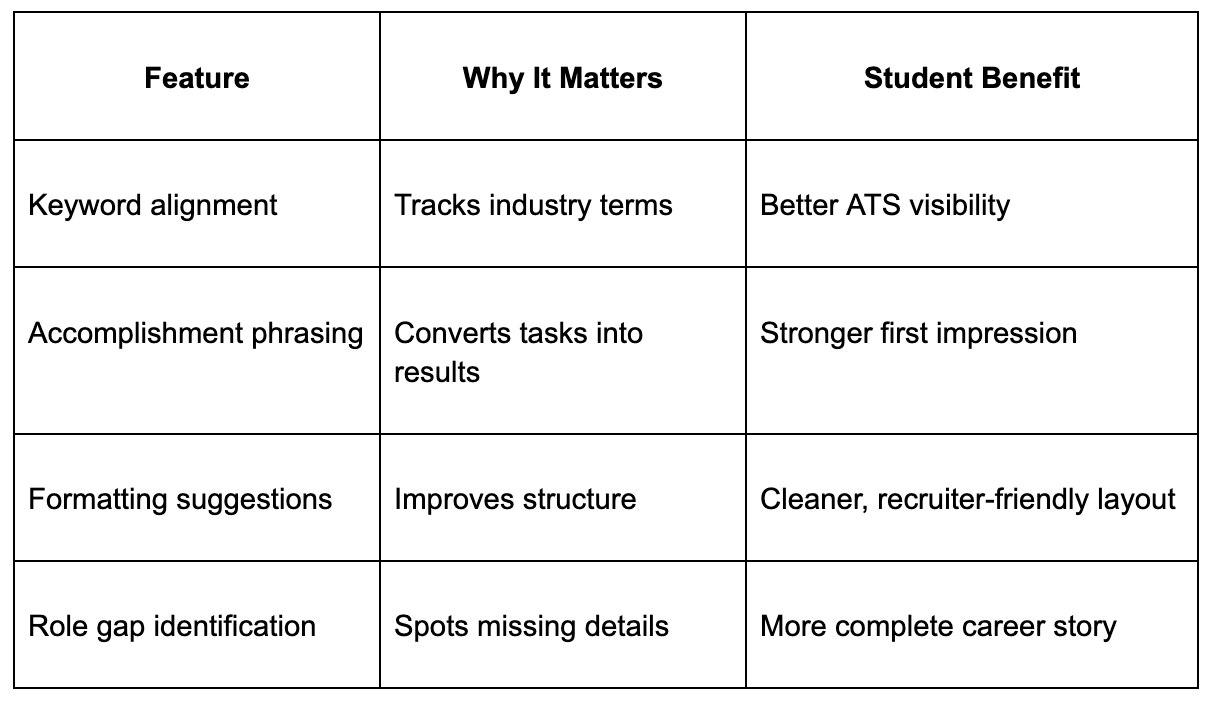
Students walk away with clarity. They know exactly how employers view their resume, and they adjust accordingly. No more shooting in the dark.
Interview Tools That Build Real Confidence
Interviews are a nightmare for everyone. Your palms, your voice, and your mind are all clammy, all flighty. Interview tools based on AI provide students with a personal area in which they are able to rehearse until their delivery is smooth and natural.
They often give you:
Feedback on expression, clarity, and speech flow
Realistic questions based on target roles
Analysis of eye contact and body posture (in some versions)
Tips on stronger storytelling during behavioral questions
One student explained it in the following manner: “I stopped sounding like someone rehearsing lines. I started sounding like someone who actually belongs in the room.”
That shift matters. It is the contrast of wishing and being ready.
Networking With More Purpose
Not every student knows how to network. Networking is sometimes assumed to be a process of sending strangers on LinkedIn an awkward message. This is no longer a matter of guesswork for AI tools.
They can:
Suggest conversation starters for industry events
Analyze public profiles and point out shared topics
Draft professional but warm introductions
Highlight plausible mentors or alumni
Map connections students didn’t know existed
An increased level of networking = higher chances of opportunities. And when you go up to a person in a clear and self-confident way, the conversation will be a natural, not a forced one.
Tools That Support Job Market Readiness with AI
The tools that students are now using are vast, and they develop day-to-day competence. These are brief glimpses of some of the everyday AI-assisted categories:
1. Skill-building tools
They help students level up rapidly.
Examples: platforms that explain concepts, generate practice tasks, or decode unfamiliar subjects.
Pros: speed, clarity, adaptability.
Cons: some tools vary in accuracy; students must cross-check critical findings.
2. Professional development platforms
These strengthen career-readiness from multiple angles.
Examples: career-matching dashboards, competency assessments, mock interview systems.
Pros: multipurpose; great for long-term planning.
Cons: broad tools sometimes feel less personalized; students should combine them with role-specific research.
3. Resume and application helpers
Tools that streamline resume-optimization and tailor it to specific industries.
Pros: saves time; reveals blind spots in content.
Cons: if students don't add their own touch, it can feel like a formula.
4. Portfolios and project generators
The students demonstrate their skills in practical work.
Pros: helps students stand out with tangible proof of skill.
Cons: must ensure originality to avoid sounding generic.
5. Interview practice tools
Tools that prepare students for high-pressure moments.
Pros: instant feedback; safe learning space.
Cons: some lack emotional nuance; always refine answers with your personality.
The above categories compose the combination of technical skill, professional sharpness, and individual confidence that the employer is seeking.
Experience Without the Need for Perfect Circumstances
Not every student receives the ideal internship, the most encouraging schedule, or the best mentor. AI tools aid in leveling the playing field.
A marketing student in a small town can turn to AI in order to explore campaigns, generate ad concepts, and practice portfolio ideas. If an engineering student does not have easy access to mentors, they can request step-by-step breakdowns or run simulation explanations. Before a professor reviews them, a biology student can prepare insights for a lab report.
These resources remove barriers that older generations had to fight through alone.
A Final Word: Real Growth Comes From Choice, Not Chance
AI gives students the ability to design their own professional growth. It replaces uncertainty with direction, anxiety with preparation, and guesswork with strategy. The purpose is not to turn everyone into the same type of worker. It’s to help each person move confidently toward the future, with the skills and insight to adapt as careers evolve.
Career readiness no longer depends on luck or the perfect mentor. Students build confidence through tools that meet them where they are and help them reach where they want to be.
If someone asked me what AI means for students entering the job world today, I would say: It means freedom. It means awareness. It means options.
And options—real options—change everything.