
Why Job Seekers Need Personal Branding Before They Need a Resume
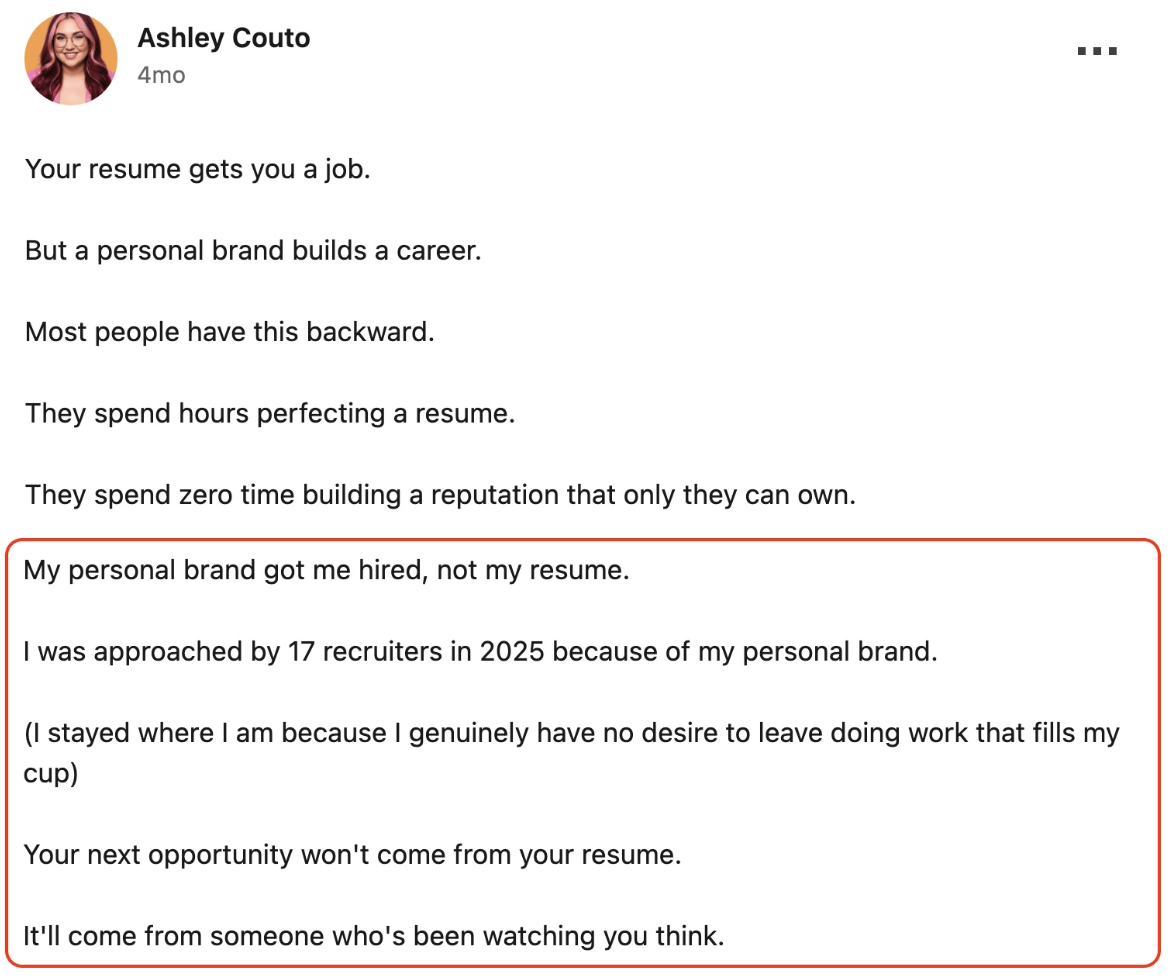
Ever since I saw this post on LinkedIn, I've been thinking: Is personal branding for job seekers overrated? Is a standard CV really not enough anymore?
Well, this might be an unpopular opinion. But most people who talk about personal branding for career opportunities make it feel too flat. It’s usually something like “it’s your opportunity to stand out in a crowded job market.” Sure, but, honestly? You can still get a job without having a single online profile.
So, why does personal branding matter before a resume?
Essentially, it gives you more freedom to choose jobs that are actually aligned with what you want. To get job offers without even applying. And to feel a sense of stability, knowing that no matter what happens, you still have this foundation to rely on.
If this sounds like something you’d be interested in, this read is for you.
Why Your Usual Resume Alone Isn’t Enough
Frankly, all that importance around CV formats and angles is often overrated. A resume is just one document. Yes, you can get creative with digital portfolios and fancy websites. But a CV as such is just a single doc that often gets no more than 6 seconds of attention.
A good resume should summarize your skills and experience well. That’s it. That’s the essence. But what’s more important is what is behind that summary:
What kind of expert are you?
What approaches do you believe in?
What is your unique thinking behind everything you do?
A CV can’t answer all these questions. But a smart professional personal branding can.
Don’t Forget About AI
It’s an important note to make nowadays. Of course, there is way too much speculation around the topic. And it’s still too early to say anything specific about how AI will impact the job market in the long run.
But most studies are pretty consistent, assuming that anywhere between 10% and 15% (around 16-25 million) of the jobs in the US alone could be eliminated. MIT study estimates a similar situation with 13.9%.
No matter what the actual number is, it’s clear that AI will transform how we work. And it’s obvious that people who have online credibility and personal authority will have more opportunities and attention by default.
How to Build a Personal Brand for a Job Search
Let’s be clear here: a professional personal branding strategy has nothing to do with becoming an influencer and getting thousands of likes. Your main goal is to show how your experience has shaped your thinking and approach to work.
These are six steps that will help you get there without turning your personal brand building into another job.
Step 1: Choose a Narrow Area of Expertise
Here is a thing: you aren’t the first person on the internet who’s been having thoughts about building a personal brand. So, positioning yourself as another “PR manager” or “lawyer” most likely won’t be enough.
That’s why it’s important to choose a narrower direction. This is how you can come up with one. Think about:
The exact task you’ve been doing (if you take 10 marketers, all of them would have different responsibilities),
Your results and achievements (things you’re particularly proud of),
Your target employer (your focus will shift depending on whether you want to work with large e-commerce, small local businesses, corporate audit, tech startups, etc.),
Your goals and aspirations (if you want to make a certain career shift, you have to account for that, too).
Once you cover these four things and write down your answers, you’ll have a much better idea of how to position your brand.
Next, simply create a so-called “tag line.” One of the best formulas you can try is key problem + who it is for + how you solve it + social proof (if possible). For example, “I help XYZ to XYZ | X stat that proves it” (number of clients, growth you help them achieve, etc.)
Step 2: Write Down What Makes You, You
No amount of personal branding tips will help you stand out until you clearly understand what you bring to the table.
The issue is that these days, simple definitions and basic explanations aren’t valuable: AI can give you any of those in seconds. So, the foundation of your brand should be different. It should feel like you. To get there, sit down and look back at your career:
What were the major lessons you got? (e.g., personal stories, things your bosses, mentors, or team members taught you).
What were your “reality checks”? (e.g., maybe there were some things that had to work in theory but turned out to be useless in practice).
What were your mistakes, and what did they teach you? (e.g., things that went wrong and can be useful for others).
How did your approaches and strategies change over time, and why? (e.g., maybe you came up with some slightly different tactics or started to have unconventional priorities, etc.).
What were your most remarkable career moments? (e.g., maybe you had some career pivots or realized that being a good expert and a good team leader were two absolutely different things, etc.)
Many people get stuck here because they think that there is nothing special about their jobs or approaches. But that’s not true. You don’t need to win a Nobel Prize to be a good specialist and an interesting person.
Besides, we tend to underestimate our own achievements, as we’re way too involved in the process. So, look into the smaller details of how you organize your workflows and get your tasks done. They are much more valuable than you think.
Step 3: Collect Your Social Proof and Measurable Results
There is one thing you have to keep in mind. When you start building your brand from scratch, you’ll talk to people who don’t know you. They have no idea how good of a specialist you are. And they have absolutely no reason to trust your words.
So, your goal is to build that trust. It will naturally come over time. But you can still help by using some trust signals:
Any reviews about your work (from your colleagues, bosses, and so on).
Any tangible results that you achieved (especially when you have screenshots or exact numbers).
Any publications in media outlets or on trustworthy industry websites.
Any big clients/employers you’ve worked with/for (when people associate you with well-known brands, it often signals credibility and safety on a psychological level), etc.
The idea is to give some real proof that you know your thing. This not only improves your overall online credibility but also has the potential to change your potential employer's perception. Because trust is the foundation of any professional brand.
Step 4: Come Up With Content Ideas Based on Your Results and Approaches
Now that you have your narrow area of expertise, things that differentiate you, and your social proof, it’s time to think of the actual content ideas. Most likely, you’ll already have some cool thoughts while going through the previous steps. But it’s also important to organize them. Think of it this way:
Take your niche and write down some of the major topics that you could potentially cover.
Look at your lists with your own experiences and results/social proof (Steps 2 & 3) and think about how you can turn them into a story.
Make sure you use one idea per post (there is a common mistake where people try to fit everything they know in one publication).
Organize all those ideas by categories (it’ll help you schedule your posts more easily and cover a diversity of topics).
As we’re talking about personal branding for professionals, you don’t really need to sell anything except for your expertise. So, it also makes things a little easier. You just have to focus on value, and it will work.
Interestingly, 77% of decision makers say they prefer to hear more specialized insights from subject matter experts rather than senior leadership. That’s why you have a serious advantage here.
Step 5: Learn to Write on LinkedIn From the Best
Most (if not all) career-focused personal branding guides suggest using LinkedIn. And in most cases, this really is the best platform to start with. So, it’s exactly what we’ll cover.
First, go to LinkedIn and see what others are publishing. If your career is somehow connected to marketing or writing, you might not need this. But in most other cases, getting some inspiration is a good idea. Some of the best approaches here are to find:
People on LinkedIn you like (pay attention to their writing style, tone of voice, post structure, etc.)
Interesting content marketing examples that can actually inspire you (these shouldn’t necessarily be personal brands; the point is to find some ideas).
Once you know things you like, you can use AI to summarize the style and help you edit your posts in the future.
Still, never write with LLMs because most readers are tired of AI slop. So, it will likely backfire. Instead, stick to your natural tone of voice, but use some tools to help you structure your posts better.
Step 6: Be Active, But Don’t Overdo It
As we’ve already mentioned, building a personal brand for career opportunities isn’t the same as becoming a blogger. So, you don’t really need a rigid schedule where the quality of your posts may suffer.
Your main goal is to create a professional image and leave an expert digital footprint. In order to achieve that, it’s much better to focus on one highly valuable post per week instead of posting something random every day.
Yet, if you still want to take it to the next level and potentially turn it into another source of income, there is this 4-3-2-1 framework you can use.
Personal Branding Isn’t Just About Standing Out to Recruiters
Once you actually start bringing your personal branding strategy to life, you’ll see that it helps you with more than just a job search. It can help you build a unique personal authority and grow a network of people who know you as a great expert.
As a result, you might get to explore an entirely new direction in life.
With that said, it’s still important to know how to write a good resume. Because relying on your brand alone isn’t the best strategy either, especially when you treat it as more of a hobby.
So, the best place to start is to keep using the old ways (aka your CV) and start trying to build something more. While it won’t deliver immediate results, your personal reputation online will give you more opportunities in the long run. That’s why it’s at least worth trying.