
Best Jobs for People With Social Anxiety (2026 Guide)
Note: The information is provided for reference only. For medical advice or diagnosis, please consult a qualified specialist.
For millions navigating the modern workplace, open-plan offices, endless Google Meet and Zoom calls, and relentless networking create overwhelming stress, especially for people with Social Anxiety Disorder (SAD). Today, with the rise of remote and hybrid work, career options, including jobs for people with social anxiety, are becoming more adaptable to mental health needs.
We developed this list after analyzing employment data and reviewing workplace psychology studies regarding task independence. The selections focus on roles with realistic entry paths and low interruption rates. Building specific communication skills can also help navigate the necessary interactions these roles require. For example, learning how to talk to anyone through structured methods can make unavoidable office small talk less taxing. You can review the following list and see what fits your routine!
Social Anxiety in the 2026 Workplace
Social anxiety is a condition where social interactions cause fear and self-consciousness. In a professional setting, this often shows up as the spotlight effect, leading you to feel that colleagues or managers are constantly watching you or judging your every move. The spotlighteffect is a cognitive bias in which individuals overestimate how much others notice or judge their actions or mistakes.
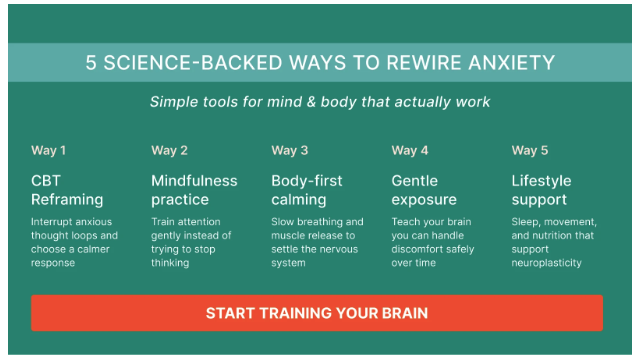
Therefore, Social Anxiety Disorder (SAD), also called social phobia, triggers intense fear of judgment in social settings, often lasting six months or more per DSM-5 standards, which refers to the diagnostic duration requirement for SAD criteria. Sure, it affects daily work, leading to avoidance of interactions that feel scrutinizing. Modern digital solutions have introduced ways to rewire anxiety; you can also use asynchronous work to solve this. This means you can:
Communicate through text, mail, audio, and Slack while working remotely
Have more time to process information and respond when you are ready, without time pressure
Work in the low-stimulus environments to cut noise, lights, and disruptions to ease sensory overload
Now, let's uncover the top jobs for people with social anxiety in 2026, backed by trends, psychological studies, and expert analysis. Mostly, we will focus on remote options, and also check how to build a fulfilling career to minimize social pressure while maximizing your strengths, like deep focus!
Quick Overview of the Top 8 Best Jobs for People With Social Anxiety
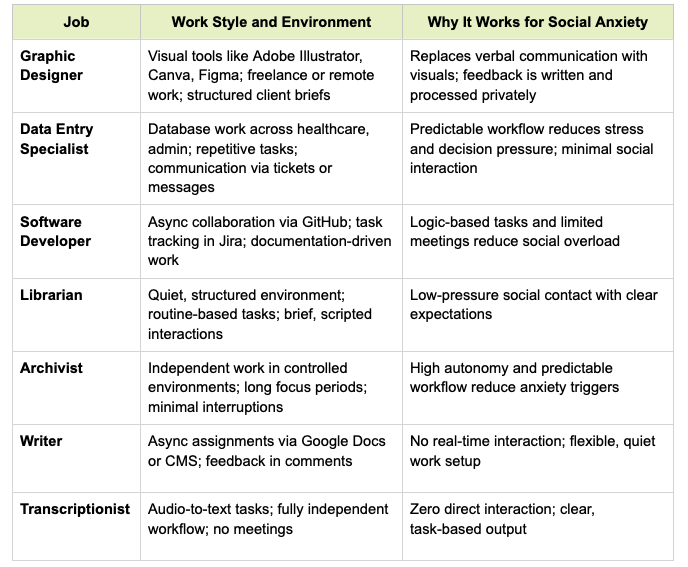
Analyzing top research results and HR charts, these jobs dominate due to low social exposure and increasing remote flexibility. This aligns with research showing that social anxiety can impair professional functioning and lead to avoidance behaviors, making job design a critical factor in career sustainability.
1. Graphic Designer: Creating Visual Work Independently
Graphic designers use platforms like Adobe Illustrator, Canva, Figma, and Photoshop to produce visual content for brands. This role allows you to replace verbal explanations with visual drafts, making it an effective path for those who prefer to show their ideas. Many designers work in freelance or remote contract capacities, which provides control over the physical work environment.
If you work in a studio, you can also use specialized apps to make friends with colleagues who share similar creative interests, often bypassing the need for large group social events. Work is typically guided by a written client brief that outlines every requirement. Feedback usually arrives via email or project management comments via Jira or Trello cards, allowing you to process critiques privately.
2. Data Entry Specialist: Working With Structured Input Daily
Data entry involves entering and maintaining information within digital databases. This role is a common entry-level remote job category because it centers on accuracy rather than conversation. Such roles are prevalent in:
Healthcare
Finance
Administrative sectors
IT niche
The work follows fixed formats, which reduces the stress of making sudden decisions. You spend the majority of your shift interacting with software and spreadsheets. Most updates or queries from supervisors happen through written messages or tickets. This predictability creates a stable environment for those who prefer to focus on a singular, tangible output.
It is also crucial to avoid passive scrolling during your work. It is better to focus on short, daily learning sessions using microlearning educational apps with bite-sized content, quizzes, and interactive formats. They help people build confidence, improve focus, and develop skills gradually in a low-pressure, non-judgmental environment.
3. Software Developer: Building Systems Through Code
Software development focuses on writing, testing, and maintaining code. Asynchronous collaboration is now a standard in the industry. This means that instead of constant meetings, developers communicate through code reviews and documentation. Developers favor written tools (e.g., GitHub, Markdown) over constant meetings, aligning with code reviews and docs as key practices.
As tasks are tracked in tools like Jira, everyone knows the status of a project without needing to ask. The logic-based nature of coding provides a clear framework for daily success. Interaction is usually task-based and documented, ensuring that social expectations remain professional and limited to the technical requirements of the build.
4. Librarian: Working in Quiet, Predictable Spaces
Librarians manage book collections and assist visitors with finding information. Library science roles rely heavily on established routines. The environment is naturally quiet, and most interactions with the public follow a clear script, such as checking out items or directing someone to a specific shelf.
Daily tasks, like cataloging new arrivals or organizing archives, are repetitive and solitary. While you do interact with people, the social pressure is low because the exchanges are brief and purpose-driven. This role offers a structured environment with clearly defined rules of engagement for both staff and visitors.
5. Archivist: Organizing Records With Minimal Interaction
Archivists preserve and organize historical records and documents. This work is detail-focused and largely solitary:
You spend significant amounts of time in climate-controlled storage areas or digital labs, categorizing items based on strict historical standards.
This job is characterized by long focus periods and a very low interruption rate.
You are often the primary person handling specific sets of records, you have a high degree of autonomy.
Your workday has a logical flow with few surprises.
6. Writer: Producing Content Without Live Interaction
Writing for blogs, technical manuals, or marketing materials allows you to work almost entirely through drafts. Freelance market data from platforms like Upwork shows that content roles are frequently asynchronous, where you:
Receive an assignment and technical requirements
Conduct research and write a copy
Submit your work through Google Docs or a content management system (CMS)
Feedback is typically left in document comments, eliminating the need for live, face-to-face editing sessions. This role offers a flexible schedule and a quiet work environment, whether you work from home or in a library.
7. Transcriptionist: Converting Audio Into Text
Transcription involves listening to audio recordings and typing the content into a document. This is an increasingly common remote role in the legal and medical fields. It requires high concentration and fast typing skills, but zero direct interaction with others during the work process.
This is a solo job with very clear output expectations. You receive a file, type what you hear, and submit the finished product. No meetings or collaborative sessions are required to complete the work. This makes it one of the most accessible jobs for those who need a completely solitary work routine.
8. Online Researcher: Gathering Information Independently
Online researchers collect data for marketing teams, academic projects, content creators, and so on. The work involves deep-diving into databases and verified sources to find specific facts. Most assignments are task-based, meaning you receive a prompt and provide a summary of your findings:
Collaboration is minimal and usually happens through email or project management apps
You get flexible hours and can work from any location
The job rewards those who can focus on a single topic for hours at a time without needing external social stimulation
Choose a Career That Matches Your Work Style and Social Energy
Selecting a career involves comparing how a role functions in daily practice and how it suits your needs and requirements. The jobs for people with social anxiety listed here prioritize task clarity, independent environments, predictable communication patterns, and market trends and popularity. This balance helps maintain professional growth while respecting your need for a lower social battery.
Preparing for the roles can happen through microlearning. You can use apps and platforms that break complex skills into small steps, helping you build confidence without the pressure of a traditional classroom. You can also explore practical tips and key ideas in books on social anxiety, then test different roles through small projects to see how they align with your daily energy and comfort level!